
Baccarat Odds, House Edge and Payouts Explained
Baccarat appeals to many table-game players because its rules are straightforward and its standard bets carry relatively low house edges compared with many casino games. This guide explains the odds and payouts for the main wagers, outlines how the house advantage works, and reviews common side bets. Use it to understand what the numbers mean before choosing a table in person or online.

The Main Baccarat Bets and How to Play Baccarat
The main game of Baccarat offers three wagers. Two have odds of winning just under 50/50 (even money), while the third succeeds much less frequently. They are:
- The Banker Bet: Wager that the Banker hand will win.
- The Player Bet: Wager that the Player hand will win.
- The Tie Bet: Wager that the Banker and Player hands will finish level.
Unlike many card games, baccarat players do not make decisions for a hand of their own. Instead, they bet on the result between two designated hands, called Player and Banker, or predict that those hands will tie.
After wagers are placed, the dealer gathers them and deals two cards to each hand. The hand with a total closest to nine wins, with third-card rules sometimes determining whether another card is dealt. The original review points readers to its how to play and win at baccarat guide for a fuller explanation of those rules and the game.
Baccarat uses a scoring method that differs from most card table games. An ace counts as one, while face cards count as zero for scoring purposes: although they carry a value of ten, totals are reduced to a single digit.
When a hand totals ten or more, discard the leading digit to get its baccarat value. Equivalently, subtract ten from the total.
How House Edge Impacts the Game of Baccarat
Like other casino games, baccarat is designed with a house edge, giving the casino a mathematical advantage over many rounds. That margin contributes to operating costs and revenue, and it varies between wagers. Baccarat's edge is low relative to many games, including video slots and roulette.
The house edges listed for the three standard baccarat wagers are:
- Banker Bet: 1.06%
- Player Bet: 1.24%
- Tie Bet: 14.36%
These figures mean the house advantage is 1.06% on Banker wagers, 1.24% on Player wagers and 14.36% on Tie wagers. For example, the original review illustrates the Banker edge this way: for each €1,000 wagered, the casino's average share is €10.60, with €989.40 returned to players. That corresponds to a 98.94% RTP (return-to-player).
The stated overall RTP for baccarat is 98.94%, but the return varies with the wager, as the figures above show.
On the listed house-edge figures, the Banker wager is the strongest of the three, followed by Player; the Tie wager has the largest edge. Banker wins are subject to a 5% commission. Even after that charge, the Banker bet remains the lowest-edge option in the figures cited, and wins more often statistically.
Baccarat Odds, Payouts, and Probabilities
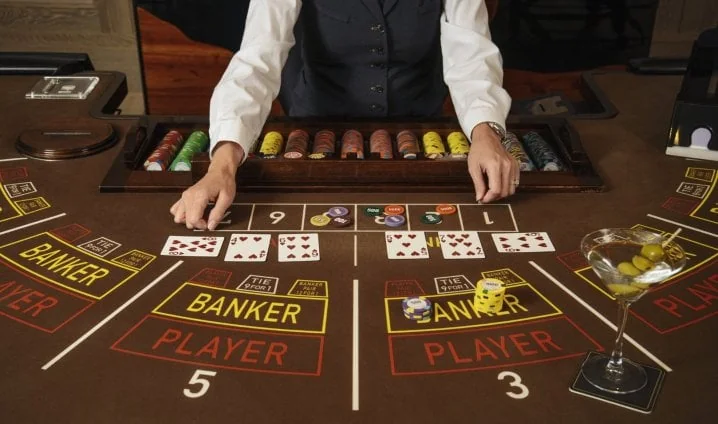
Before playing standard baccarat, it helps to compare the chance of each outcome with its payout. The following sections set out the probabilities and returns attached to the three main bets.
Banker Bets
The Banker wager wins 45.86% of the time in the figures provided, accounting for Player and Tie outcomes as well as the house edge. A winning Banker bet returns 0.95:1, reflecting the 5% commission described above.
Player Bets
The Player bet has a stated win probability of 44.63%, a little below the Banker's and well above the Tie's. A Player win pays 1:1. That return is higher than the Banker payout because no commission is charged on winning Player wagers.
Tie Bets
A third option is to predict a tie between the Banker and Player hands. Ties happen less often than either hand winning: the stated probability is 9.51%, or roughly once in ten rounds. The larger payout compensates for that lower frequency, with a winning Tie bet paying 8:1.
How the Number of Decks Affects the Baccarat Odds
The odds discussed so far refer mainly to standard baccarat played with eight decks, described in the original review as the most common format in land-based and online casinos. Some versions use fewer decks, which can alter the probabilities slightly. The review notes that fewer decks improve the odds for players.
- Six-Deck Baccarat: With six decks, the Player bet wins 44.63% of the time. Banker wins occur 45.87% of the time, while Tie wins occur 9.51% of the time.
- Single-Deck Baccarat: With a single deck, the stated win rates are 44.68% for Player, 45.96% for Banker and 9.36% for Tie.
Baccarat Side Bets
Alongside Player, Banker and Tie, some baccarat tables include optional side wagers. Rules and returns depend on the game; common examples include:
- Pair Bets: A pair wager predicts that the Player or Banker will receive two cards of the same rank. Banker Pair payouts differ by game, with 11:1 given as a typical winning return.
- Perfect Pair: This bet narrows the prediction to the first two cards dealt to either hand matching in both rank and suit. The stated returns can range from 25:1 to 200:1, depending on the casino.
- Big and Small: In some versions, the wager is on the number of cards dealt to both hands combined: a "Big" result means 5 or 6 cards, while "Small" means 4. Payouts vary and are generally even money or near it.
- Dragon Bonus: This side bet predicts the margin by which either the Player or Banker wins. Larger victory margins attract higher returns, with payouts stated as ranging from 1:1 to 30:1 or more.
- Super 6: A Super 6 side wager is available at some Baccarat tables. It pays when the Banker wins the hand with a total of 6 points; the typical payout is 12:1.
- Lucky 8 or 9: This wager backs the winning hand, Player or Banker, to finish on 8 or 9 points. Its stated payout is usually 10:1 or 11:1.
Strategies to Help Beat Baccarat Odds
Baccarat outcomes are chance-based, and no approach can remove that randomness or ensure a player wins more than they lose. The probabilities for Player and Banker do not change with a betting method. The suggestions below may help players stay informed and limit avoidable losses.
- Bet on the Banker: The Banker wager has the lowest house edge among the main options and wins more often statistically. Remember that a commission is usually deducted from winning Banker bets.
- Stay Informed: Learn the rules, probabilities and house edge before wagering. Familiarity with how the game works can support considered choices and reduce rule-related errors.
- Short Sessions: Keep play periods brief and manageable. Taking breaks can help maintain attention and curb spur-of-the-moment decisions.
- Avoid the Tie Bet: The Tie wager is a particularly poor choice, with odds among the weakest in baccarat. Its infrequent wins do not make it more likely after a long wait, so a delay alone is no reason to place this bet.
- Bankroll Management: Set a portion of your available bankroll for each hand and follow that limit. A plan can help you pace play; avoid trying to recover losses by increasing bets.
- Quit While Ahead: Consider ending a session if you are ahead, since continued play can give back winnings. The house edge still favours the casino over the long run.
- Practice: Some RNG baccarat games can be played without real-money wagers. They offer a way to learn the rules without staking cash, before deciding whether to try another format.
- Consider Using a Betting System: A staking system cannot improve the underlying baccarat odds or guarantee a profit. The original review mentions Martingale, which doubles the wager after each loss; this changes bet size, not the chance of winning.
- * The original review also directs readers seeking more detailed approaches to its Baccarat strategy guide.
Different Baccarat Variations
Beyond the standard format, baccarat has several variants. Online casinos may not offer every version, so availability depends on the game selection.
- Chemin de Fer: Popular mainly in Europe, particularly France, Chemin de Fer uses somewhat different third-card rules. Players may still bet on Banker, Player or Tie. The stated house edge ranges are 1.29% to 1.45% for Banker and 1.01% to 1.45% for Player.
- Dragon Tiger: This simpler variant deals one card to each of two positions. Rather than Banker and Player, the choices are Dragon, Tiger or Tie. Its stated house edge ranges from 2.7% to 3.7%, depending on the title.
- Baccarat Banque: A French form usually associated with land-based casinos, Baccarat Banque has three hands: two Player hands and one Banker hand. The largest wager determines who acts as Banker. The stated Banker house edge is between 1.06% and 1.24%, depending on where it is played; the Player edge ranges from 1.28% to 1.46%.
- Mini-Baccarat: This smaller, streamlined format keeps Banker and Player hands but seats fewer people at the table. The review describes it as quicker, allowing more wagers per hour, with the same payouts and house edge as baccarat.
- No Commission Baccarat: Most standard rules remain, but winning Banker bets do not incur a commission. The adjustment described is a reduced return when Banker wins with a total of 6: instead of 1:1, the payout is 1:2, so the player wins only 50% of the wager. The stated house edge matches the standard game.
Live Dealer Baccarat Casino Games
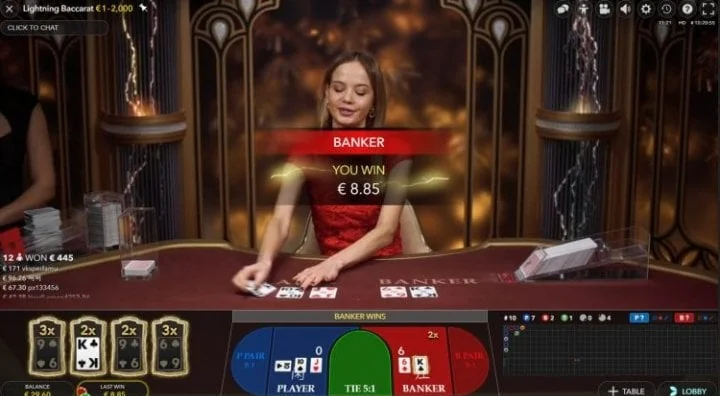
For those considering online play, the original review describes Baccarat as available on desktop PC, laptop computer and mobile device. It says online casinos commonly provide several formats, including side bets like those found at land-based tables. The game’s house edge is not the lowest among table games, though the review characterizes it as one of the lower ones. For Canadian readers, online availability described in a UK source does not establish that a site is authorized in Canada. Explore online Baccarat to learn about the formats discussed.
The original review highlights several online baccarat titles for readers to look for. Baccarat can be offered as an RNG game or in a live casino format, where a dealer presents the game in real time.
- Speed Baccarat: Some iGaming developers offer a faster format with shorter decision windows, allowing more hands per hour. The stated probabilities and house edge remain the same as standard baccarat.
- Lightning Baccarat: The original review describes Evolution's Lightning Baccarat as a Player, Banker and Tie game with random multipliers attached to Lightning Cards. A winning hand can receive multipliers between 2x and 8x. If multiple cards apply to a winning wager, they can stack up to 262,144x the bet. To offset these multipliers, Tie wins pay 6 times the stake instead of 9. The stated house edge is 1.24%.
- Peek Baccarat: Also attributed to Evolution, Peek Baccarat lets players pay a 20% fee on top of their stake to look at up to 4 cards, then use that information to double or triple the initial bet. The review says it shares standard baccarat's house edge, odds and probabilities.
- Baccarat Squeeze: This format is described as retaining the original game's odds and house edge while changing its presentation. The live dealer slowly reveals, or squeezes, the cards to build anticipation.
- No Commission Baccarat: As noted among the other variants, this version removes commission from winning Banker wagers but adjusts the payout instead. Player wins pay as usual; a Banker win pays half the standard amount.
Conclusion

Baccarat odds help compare the main wagers: Banker has the lowest house edge in the figures presented, while Tie carries a much higher edge despite its larger payout. Knowing those trade-offs can clarify what each bet offers, but it cannot ensure a win or change the game's underlying chance.