
Blackjack Variants and Versions
Blackjack has travelled widely and branched into numerous forms over centuries of play. Different versions bring distinct table rules and optional side bets, shaping how a hand unfolds while retaining the familiar contest against the dealer. Online casinos may present several rule sets under the blackjack name. This guide surveys a selection of widely recognized variations.
European Blackjack
European Blackjack keeps the familiar contest against the dealer: build a hand worth 21, or as near to it as possible, without busting. Its core objective is much like that of other blackjack games, while its dealing and player-action rules give the version its own character.
This version appears in online casino game selections. Players who already understand basic blackjack may find it a useful way to explore a different ruleset; the specific table rules should still be read before play.
European Blackjack Rules
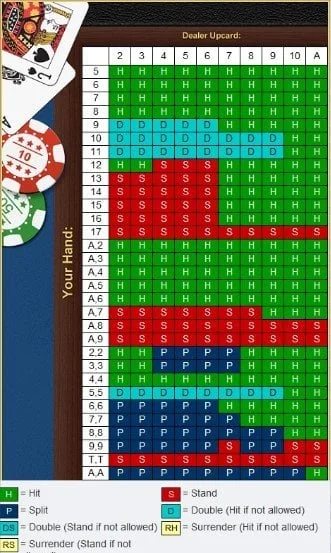
Play uses two standard decks. The player receives two cards face up, while the dealer initially gets a single face-up card and no second card. When that visible card is an ace, the player may place insurance for half the original wager. The insurance result is settled once the hand concludes.
After deciding whether to insure, the player takes their turn. Doubling is restricted to hard totals of 9, 10 or 11. Any pair may be split except two different cards worth 10; doubling after a split is not permitted. Aces may be split, and players may draw on split aces. Surrender is unavailable.
European Blackjack Dealer’s Rules
The dealer stands on every hand worth 17, including both soft 17 and hard 17. During the player's turn, the dealer has only one card, which remains visible. An ace showing prompts an offer of insurance. That wager is settled at the end of the hand because the dealer cannot draw a second card until the player has finished making decisions.
If the player busts, the dealer generally does not need to draw again. An insurance wager is the exception: the dealer takes a second card to check for a natural blackjack, and if one is present, the insurance wager is paid.
European Blackjack Strategy
Vegas Strip Blackjack
Named for Las Vegas’s famous casino district, Vegas Strip Blackjack is a widely recognised format found in land casinos and online casinos. Table rules can differ in small but meaningful ways, so review the posted rules at the casino before starting a game.
The aim here follows the familiar pattern in many blackjack versions: you play against the dealer, trying to make a hand worth 21 points or finish nearer to that total without going over. The winner is the player whose hand beats the dealer's while staying within the limit.
Vegas Strip Blackjack Rules
This version uses four decks. The deal proceeds in sequence: one face-up card to you, one face-up card to the dealer, your second card face up, and then the dealer’s second card face down as the hole card.
An ace showing for the dealer brings an insurance offer worth half your original wager. The dealer checks the hole card for blackjack; if the dealer has it, your original wager loses and the blackjack insurance wager wins.
With a 10-valued up card, the dealer also checks for blackjack. In that situation, however, insurance is not offered. A dealer blackjack means your wager loses.
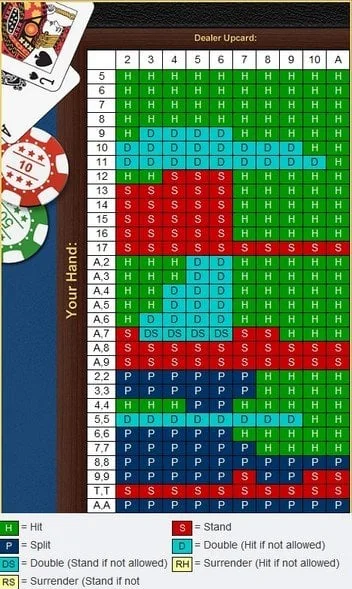
If the dealer has no blackjack, play passes to you. You may double on any first two cards and may double after splitting. Pairs can be split as many as three times, creating up to four hands in total. Aces can be split once only, and each resulting hand receives just one card. An ace paired with a 10-valued card after splitting totals 21 but is not a natural blackjack.
Vegas Strip Blackjack Dealer’s Rules
The dealer stands on every hand valued at 17, whether soft 17 or hard 17. A dealer bust means you win, even if your own hand total is low. If the dealer stays in play, the two totals are compared to see which is closer to 21. Matching totals result in a Push (tie), and your original bet is returned.
Vegas Strip Blackjack Strategy Chart
Double Exposure Blackjack
Double Exposure changes the usual information balance by dealing both of the dealer’s cards face up, which is why the game is also sometimes called Face Up 21. Seeing the complete dealer hand can help the player, so other rules are adjusted to favour the house. The result is a recognisable blackjack contest with a different set of trade-offs.
The format is described as available at many online casinos and at land casinos in the US and Asia. As in other blackjack games, the player aims to beat the dealer with a total of 21 or a hand closer to 21, or to win when the dealer busts.
Double Exposure Blackjack Rules
The game uses 8 decks. Each round begins with two face-up cards for the player and two face-up cards for the dealer. Doubling is allowed on hard 9, 10 or 11, including after a split. Split aces receive one card apiece.
Seeing both of the dealer’s cards can change the decision from regular blackjack. If the dealer’s hand is worth 20 and yours is 18, hitting involves a risk, but drawing a 3 would bring you to 21 and win. If you stand, your 18 remains below the dealer’s total. With both cards exposed, you can weigh that possible improvement against the chance of taking a worse card.
The open dealer hand is balanced by even-money payouts on every winning hand. That includes a natural blackjack, which also pays 1-to-1.
Double Exposure Blackjack Dealer’s Rules
The dealer draws on soft 17 and stands on hard 17. The dealer wins tied hands except when the tie is blackjack. If both hands total 21, the player wins and receives a 1-to-1 payout.
Strategy Advice
When the dealer’s displayed total is hard 17, or 18 whether soft or hard, the dealer must stand. You need to draw if your aim is to pass that total, while recognising that a draw could also bust your hand.
A dealer total of 12, 13, 14, 15 or 16 requires another card, leaving a chance the dealer will bust. If drawing could bust your own hand as well—at a total of 12 or more—standing avoids that immediate risk and leaves the dealer to complete their hand.
Perfect Pairs Blackjack
Perfect Pairs adds a separate wager to the regular blackjack game. The side bet pays when the player's first two cards form one of the qualifying pairs. The version has been popular in casinos in London and Macau, with interest also noted among Australian, European and Asian players.
Online versions have been associated with games from Microgaming, Playtech, NetEnt and other providers. Its popularity has been described as growing, though a casino’s actual game selection depends on its own offering.
Perfect Pairs Rules
Perfect Pairs can use the rules of Vegas Strip Blackjack or European Blackjack, with the side wager added. The game may use 2 to 8 decks. In principle, the side bet can be attached to other blackjack variants too, without changing their underlying rules.
The wager predicts whether the player's initial two cards will make a pair, and it must be placed before the deal. The table has two betting spots: one for the main blackjack wager and another, marked “perfect pairs,” for the side bet.
The side wager can be a different amount from the regular blackjack bet, subject to the table’s minimum and maximum limits.
The Perfect Pair wager is resolved immediately after the first cards are dealt. Only after that payout is settled can the usual actions—Hit, Split or Double Down—begin.
Types of Pairs
Three pair categories can qualify for a payout:
- Perfect Pair – two cards identical in rank and suit, such as two 9’s of hearts or two Queens of Spades
- Colored Pair – two cards of the same rank and colour, for example a 9 of hearts and a 9 of diamonds
- Red/Black Pair – two cards with matching rank but different colours, such as a 10 of diamonds and a 10 of spades
Perfect Pairs Blackjack Odds
For standard play with 8 decks, these are the odds often given for Perfect Pairs Blackjack. Casinos can set different terms, so check the applicable odds before placing a side wager.
Pair Payout No. of Combinations Probability Perfect Pair 25:1 1456 1.6867% Colored Pair 12:1 1664 1.9277% Red/Black Pair 6:1 3328 3.8554% No Pair -1 79872 92.5301% Total 86320 100%
Some casinos pay 30:1 for a Perfect Pair and 15:1 for a Colored Pair. Payouts and odds vary by venue, making it important to consult the table information where you play.
Spanish 21
The review dates this blackjack variant’s introduction to Nevada in 1995 and describes it as a fast-growing favourite. Its quicker rounds bring a lively, action-packed pace; the source also claims players have a greater chance of winning.
Origin of Spanish 21
The game’s creator was a casino employee seeking a faster, more lively blackjack format. Masque Publishing, based in Colorado, USA, later purchased the game; the company is the sole issuer of licences for its use.
Comparable versions without a licence may be labelled Spanish Blackjack. In Australia, a modified ruleset became known as Australian Pontoon.
Despite a name that may lead people to associate it with Spain or Latin America, the game originated in the United States. Its label comes from the “Spanish deck” used for play: it leaves out all natural 10's, so the deck contains 48 cards.
Changes to House Edge
In blackjack, the presence of 10-valued cards can affect the player’s prospects against the dealer. Card counters regard a shoe rich in 10’s, both natural and unnatural, as favourable to the player and may respond by increasing their bets.
Taking the natural 10’s out of the deck raises the house edge. Special rules and bonus payouts offset that change; the stated house edge is 0.40% when the dealer stands on soft 17 and 0.42% when the dealer hits soft 17 but redoubling is allowed.
Depending on the rules and house edge at a particular casino, Spanish 21 may be a better choice for a player than that casino’s blackjack game. The comparison depends on the specific tables involved.
Spanish 21 Rules
- Play uses six or eight decks, with 48 cards in each deck: a 52-card pack with the four 10's removed. Cards may come from a shoe or a continuous shuffling machine (CSM).
- Any pair may be split, with no restrictions on pair splitting; aces may also be split.
- Aces may be split again.
- After splitting aces, the player may hit or double down.
- Doubling after a split is permitted.
- A player total of 21 beats a dealer total of 21.
- The player's blackjack beats the dealer's blackjack.
- Late Surrender is available.
- Double Down Rescue is available: after doubling down, the player may surrender and lose only the original bet.
- The player may double down after any number of cards.
Bonus 21
A hand that reaches a total of 21 may qualify for a special bonus payout:
Cards Suit Payout 5 Cards Mixed Suit 3:2 6 Cards Mixed Suit 2:1 7 or More Cards Mixed Suit 3:1 6-7-8 Mixed Suit 3:2 6-7-8 Same Suit 2:1 6-7-8 Just Spades 3:1 7-7-7 Mixed Suit 3:2 7-7-7 Same Suit 2:1 7-7-7 Just Spades 3:1
Super Bonus
A Super Bonus is possible in Spanish 21 when the player holds 7-7-7 of one suit and the dealer draws a 7 in any suit.
A bet from $5 to $24 usually receives a $1000 Super Bonus; bets of $25 and over usually receive $5000.
Super Bonus schedules can differ between casinos, so consult the table’s terms before playing. In most casinos, splitting or doubling cancels eligibility for the bonus.
Envy Bonus
If a player wins the Super Bonus, each of the other players at the table receives an Envy Bonus of $50.
Blackjack Surrender
Blackjack Surrender is named for an option that lets a player give up a hand after the initial deal. If they choose to surrender, half of their wager is forfeited and the other half is returned.
The format is popular in Europe and is offered by many European casinos and in the Best Online Casinos.
Blackjack Surrender Rules
The surrender option can, in principle, be added to many blackjack formats. Other rules continue to follow the chosen variant, with surrender as the added choice.
For illustration, consider late surrender under these rules:
- Dealer draws on 16 and lower, and stands on all 17s
- Re-splitting is not allowed
- Doubling after a split is allowed
- Players may not hit split aces
- An ace and a 10-valued card in a split hand are not a natural blackjack
- Insurance pays 2:1
How to play
Play begins with the player placing a wager and receiving two cards. If the dealer’s up card is an ace, insurance is available. With a 10-valued up card, the dealer checks for blackjack; if one is present, the original wager loses and the insurance wager pays 2 to 1.
If both the player and dealer have a natural blackjack, the main wager is a Push, while insurance pays at 2 to 1.
When neither hand is a natural blackjack, the player may surrender before taking another action. Half the original wager is returned and the other half is lost.
This option is called late surrender. Early surrender is another version, where the player acts before the dealer checks for a natural blackjack. It may also be offered in no-hole-card blackjack.
Early surrender was once standard at many Atlantic City casinos. It later disappeared from US casinos because it gives the player a greater advantage than late surrender.
The Benefits
In a blackjack game with late surrender, the rule lowers the house edge by about 0.07%. That reduction improves the player’s chances compared with the same game without the option.
The Pitfalls
Having the option to surrender can lead players to give up too many hands simply because a loss seems possible. The stated optimal approach reserves surrender for the weakest hands: even a small chance of winning the full wager can be preferable to automatically losing half of it.
Atlantic City Blackjack
Atlantic City Blackjack is a widely played blackjack format named for the American East Coast gambling centre where it originated. It is also offered in online casino selections, though rules can vary between games.
As in other blackjack variants, the player tries to beat the dealer’s hand. A total of 21 is ideal; otherwise, the goal is to get as close as possible without exceeding 21.
Atlantic City Blackjack Rules
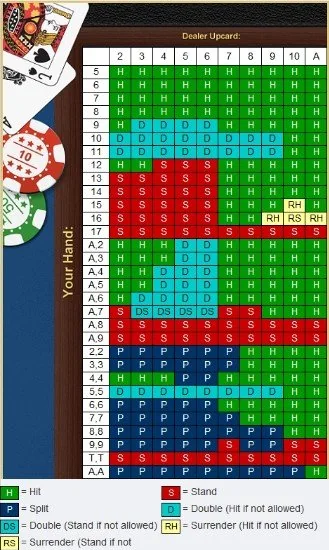
The game is dealt from 8 decks and allows surrender. After the player wagers, they receive two face-up cards. The dealer receives one face-up card and one face-down hole card.
When the dealer shows an ace, the player may insure against a natural blackjack for half the original wager. A winning insurance bet pays 2-to-1. If the up card is worth 10, the dealer checks for blackjack as well, but does not offer insurance.
Once the dealer has confirmed there is no blackjack, the player acts. Doubling is allowed on any two cards, including after splitting, but re-splitting is not permitted. Split aces receive one card each. If a split ace gets a 10-valued card, that hand totals 21 but is not a blackjack, so it does not receive the increased 3-to-2 payout.
Atlantic City Blackjack Dealer’s Rules
Once the player stands, the dealer takes a turn. The dealer must hit on any total of 16 or less and stand on 17, whether hard 17 or soft 17. If the dealer busts, the player wins whatever their own total. Otherwise, the dealer's and player's hands are compared to determine which is closer to 21.
Atlantic City Blackjack Strategy Chart
Big Five Blackjack
Big Five stands out for its five-deck shoe. Blackjack is more commonly dealt from four, six or eight decks, and some formats use one or two. This comparatively recent variant has also appeared in online casinos.
Big Five Blackjack Rules
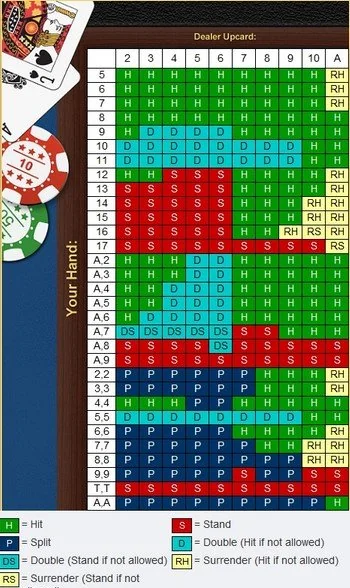
- Uses five decks
- Dealer hits on soft 17
- No-hole-card game; the dealer does not peek
- Doubling down is allowed on all hands
- Doubling after a split is allowed
- Aces may be split
- Split aces receive one additional card only
- Early Surrender is allowed unless the dealer shows an ace
- Insurance pays 2-to-1
- Blackjack pays 3-to-2
How to Play Big Five Blackjack
After placing a wager, you receive two face-up cards and the dealer receives one face-up card. You may surrender at this point if you judge the hand unlikely to win; doing so costs half of your original wager.
If the dealer’s visible card is an ace, insurance is offered. Otherwise, play moves to your turn. You can stand on your total or hit to take more cards, aiming to improve the hand without going above 21.
If your opening two cards make doubling attractive, you can double your original wager and receive one additional card. The choice is to take that single card rather than continue drawing.
When your first two cards form a pair, you may split them into two hands. Doubling is also possible on split hands, except when the split hands are aces.
Once you have finished acting, the dealer draws the second card. On soft 17 or any lower total, the dealer continues drawing until reaching hard 17 or more, or busting. A dealer bust wins the hand for you regardless of your own total.
Big Five Blackjack Strategy
Other Blackjack Variations
Dealer Stands on Hard 17 – in this ruleset, the dealer draws below 17, including on soft 17, a hand where an ace counts as 11.
Dealer Stands on Soft 17 – the dealer stops drawing on any total of 17, including a soft hand containing an ace.
21 Duel Blackjack – players cannot split, double down or take insurance. Wagers pay at even money, and the aim is simply to beat the dealer without busting.
Blackjack Switch – you place wagers on two hands and may exchange cards between them after the opening deal. The dealer draws on Soft 17. An optional “Super Match” side bet pays for combinations among your original four cards: a pair pays 1 to 1, three of a kind 5 to 1, two pairs 8 to 1 and four of a kind 40 to 1.
Pontoon – the dealer’s two cards are both face down. It uses its own vocabulary: “Buy” means double, “Stick” means stand and “Twist” means hit. A Pontoon pays 2 to 1. Players may “Buy” after splitting and split to a maximum of three hands.
Double Attack Blackjack – the dealer’s first card is dealt face up before the player acts. The player may then double the wager before receiving cards. Insurance pays 3 to 1. If the dealer shows 10 and checks for blackjack, a dealer blackjack forfeits the original wager but returns the Double Attack wager. Doubling is allowed on any initial two cards and after splitting aces.